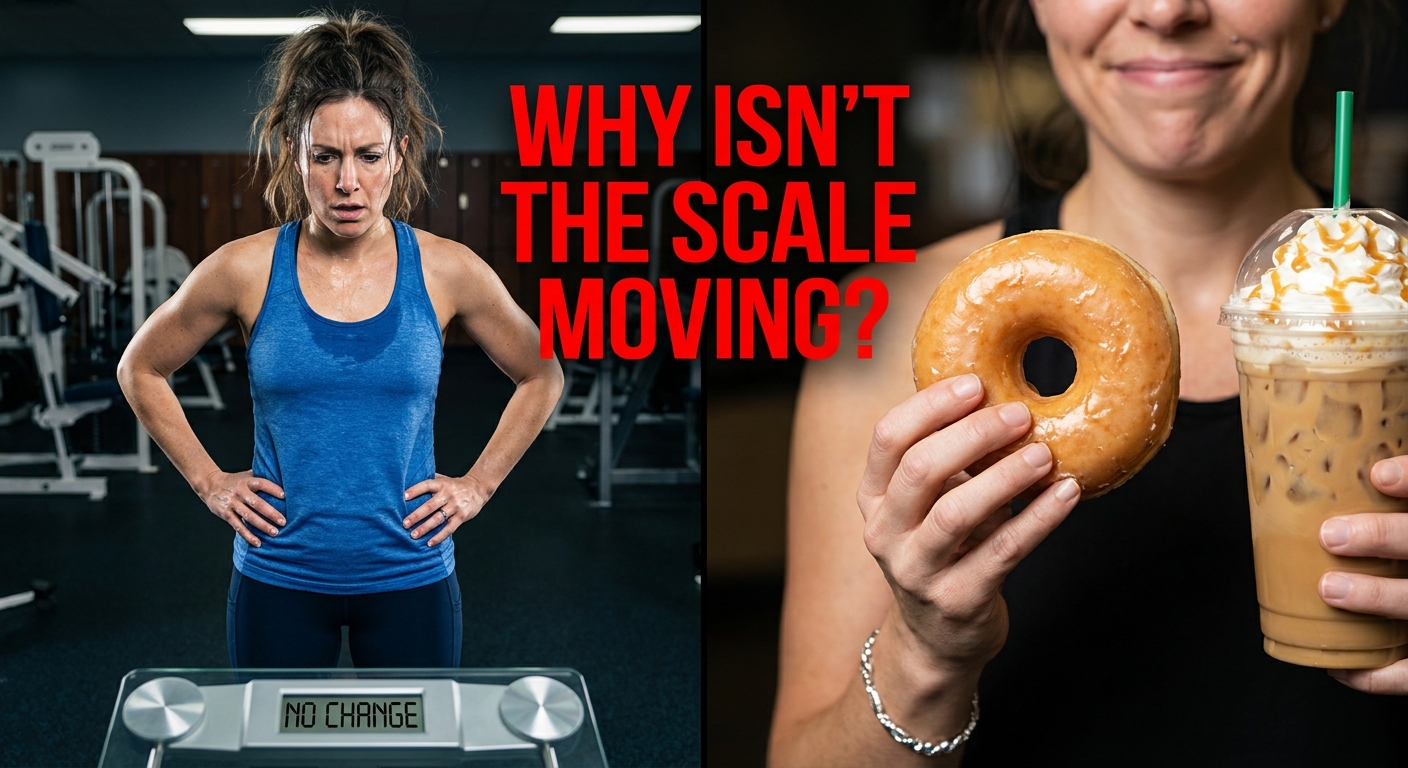
If you’re exercising and not losing weight, you’re not broken — and you’re not alone. You workout five days a week. You sweat. You ache. The scale laughs at you anyway.
If you’ve ever stared at that number and felt cheated, this post is for you. Today I’ll answer the question millions of frustrated gym-goers ask: why am I exercising and not losing weight? Let me show you what’s really going on.
The Skeptic in the Room: Who This Post Is For
Before I write another word, let me picture the person who hates this topic most.
She’s 38. She runs three times a week. She lifts weights on Tuesdays and Thursdays. She’s been at it for six months. She’s lost two pounds.
Her objection sounds like this: “Don’t tell me exercise doesn’t matter. I’m working my ass off. The problem is my metabolism, my hormones, my age — not my effort. Stop blaming me.”
I hear you. And here’s the thing.
You Are Completely Right About Exercise and Weight Loss
You are completely right that exercise matters. You are completely right that your effort is real. You are completely right that something feels broken when you do everything “correctly” and nothing changes.
You’re right that your metabolism slows with age. That’s a real biological fact, not an excuse. After 30, most adults lose 3-8% of muscle mass per decade, which lowers daily calorie burn.
You’re right that hormones shift. Cortisol, insulin, estrogen, thyroid — they all play a role. Anyone who pretends otherwise is selling you something.
You’re right that the fitness industry has lied to you. “Just move more” is a bad answer. Some trainers say “calories in, calories out.” They ignore sleep, stress, and hunger signals. That’s too simple for a complex system.
You’re right that two people can eat the same meals and one gains weight while the other doesn’t. Genetics are real.
You’re right that exercise alone — by itself, with no other changes — rarely causes major weight loss. The research backs you up here. A 2021 review in the British Journal of Sports Medicine found exercise without dietary change produces modest results at best. A landmark Harvard study tracking 12,000 runners found that runners who didn’t change their diet still gained weight year after year.
You’re right to be frustrated. You’re right to feel lied to. You’re right that “just work out harder” is bad advice.
So let me say it plainly: the problem isn’t your effort.
Here’s the Bridge: Why Exercise Isn’t a Weight Loss Tool
But if exercise alone can’t move the scale, that proves the exact thing most people miss — exercise was never supposed to be the weight loss tool in the first place.
Let me explain what I mean.
Why Am I Exercising and Not Losing Weight? The Quick Answer
You’re exercising and not losing weight because exercise burns fewer calories than you think, while triggering hunger and slower metabolism that erase the deficit. Real fat loss happens through a calorie deficit created by food, not workouts. Exercise builds health and muscle. Food controls weight. They are two different jobs.
What Exercise Actually Does to Your Body
Your workout burns calories. Yes. But far fewer than the machine claims.
A 150-pound woman running for 30 minutes burns around 250 calories. That’s a granola bar and an apple. That’s it.
Meanwhile, your body fights back in three sneaky ways:
- It makes you hungrier. Hard workouts spike ghrelin, your hunger hormone.
- It makes you move less the rest of the day. This is called “compensation.” You take the elevator. You sit longer. You skip the dog walk.
- It slows your resting burn. Your body adapts. The same workout burns fewer calories over time.
This is why your scale isn’t moving. Not because you’re lazy. Because biology is doing exactly what it evolved to do — protect your weight.
The Real Job of Exercise for Fat Loss
So if exercise isn’t the fat-loss lever, what is it?
Exercise builds muscle. Muscle changes your shape. It also raises your baseline calorie burn slightly over time.
Exercise improves insulin sensitivity. That helps your body store less fat from the food you eat.
Exercise protects your heart, your brain, your mood, and your sleep. All of these affect weight indirectly.
Exercise makes the food choices easier. After a hard workout, most people don’t crave a binge. They crave protein and water.
But the actual fat loss? That happens at the kitchen table.
The Calorie Deficit Math Doesn’t Lie
Here’s a quick math check that might sting a little.
One pound of fat equals roughly 3,500 calories. To lose one pound a week, you need a 500-calorie daily deficit.
Burning 500 calories through exercise means about 60 minutes of hard running. Every single day. No rest.
Cutting 500 calories from food means skipping one large latte and one bagel. That’s it.
Which one sounds sustainable?
What’s Actually Stopping Your Weight Loss
Let me give you the real list. The honest one. After ten years of coaching clients through this exact problem, these are the six culprits I see again and again:
- Liquid calories. Lattes, juice, wine, sports drinks. Easy to drink, easy to ignore.
- Weekend eating. Five days perfect, two days off plan equals zero progress.
- Hidden snacks. The handful of nuts. The kid’s leftover mac and cheese. The “tastes” while cooking.
- Sleep debt. Less than seven hours raises hunger hormones the next day.
- Stress eating. Cortisol drives cravings for sugar and fat.
- Underestimating portions. A 1992 New England Journal of Medicine study found people undercount their food intake by 47% on average.
None of these have anything to do with your workout. That’s the point.
A Real Example of Exercise Without Weight Loss
Let me tell you about Sarah. Not her real name.
Sarah came to a registered dietitian after a year of CrossFit. Five classes a week. Lost three pounds total.
The dietitian asked her to log her food honestly for one week. Just write it down. No judgment.
Sarah found 400 hidden calories a day. A protein shake here. Almond butter on toast there. Wine on Friday. A “small” pasta portion on Sunday.
She didn’t change her workouts. She didn’t add any cardio. She just got honest about the food.
She lost 18 pounds in four months.
Why This Reframe Sets You Free
Here’s the good news buried inside this hard truth.
If exercise was the answer, you’d need to do more of something already exhausting. You’d need to add hours you don’t have.
But if food is the lever, you can lose weight while doing less exercise, not more. You can rest. You can recover. You can stop punishing yourself.
You get to keep your workouts because they make you feel good. Strong. Capable. Sane.
You stop using them as punishment for what you ate. They become something you do for joy.
How to Actually Move the Scale: A Simple Plan
Want a simple plan that works? Here it is.
- Track everything for one week. Just one. Use an app like MyFitnessPal or Cronometer. Be brutally honest. You’ll find your hidden calories.
- Cut 300-500 calories a day from food. Not from exercise. From food.
- Eat protein at every meal. Aim for 30 grams. It kills hunger. Research from the American Journal of Clinical Nutrition confirms higher protein intake reduces total daily calories eaten.
- Sleep seven hours minimum. Non-negotiable.
- Keep your workouts. But stop expecting them to do the fat loss job.
- Weigh yourself weekly, not daily. Same day, same time.
That’s it. No magic. No supplements. No detox tea.
The Mindset Shift Behind Real Weight Loss
The hardest part isn’t the food. It’s giving up the story.
The story that says “I exercised, so I earned this.” That story keeps you stuck.
The new story is simpler. Exercise is for your body’s health. Food is for your body’s weight. They’re two different jobs.
When you stop asking your workout to do food’s job, both jobs get done better.
One More Thing About Your Frustration
Your frustration was never wrong. It was data.
Your body was telling you that something in the equation didn’t add up. You assumed the broken part was you. It wasn’t.
The broken part was the advice. “Exercise more to lose weight” is incomplete. It sets up millions of people to feel like failures when biology kicks in.
You’re not a failure. You were given the wrong tool for the job.
The Bottom Line
So the next time you ask yourself why am I exercising and not losing weight, stop blaming the gym. Start checking the kitchen. Your workouts are doing their job. Your food isn’t.
Pick a day this week. Any day. Track every bite, sip, and taste — no changes yet, just observation. Open the app tonight, set it up, and start tomorrow morning with breakfast. That’s the move. Make it.